CBG CNG project consultancy becomes valuable long before a compressor, cascade or dispenser reaches the site. A project may look straightforward on paper, but the real work begins when feedstock, gas demand, site conditions, approvals, equipment sizing, storage, dispensing and future operations have to work together as one system.
For project developers, that is one of the clearest practical takeaways from the CBG-focused discussions and themes around IBET Expo 2026 in Greater Noida. The event brought technology suppliers, project developers, policy stakeholders and clean-energy businesses into the same conversation, making it easier to see where projects commonly need stronger planning before capital is committed.
IBET Expo 2026 is being held from 11–13 August 2026 at the India Expo Centre & Mart, Greater Noida, Uttar Pradesh. Sanmish Energies is participating at Hall A, Stall A-40, where project developers can discuss CBG/CNG infrastructure, equipment and consultancy requirements.
Quick takeaway: A successful CBG or CNG project is not simply a collection of equipment. It needs coordinated engineering, approvals, procurement, execution and operating planning from the beginning.
Table of Contents
Why CBG CNG Project Consultancy Matters Before Equipment Selection
A common mistake in gas infrastructure projects is to begin with equipment quotations instead of the operating requirement.
A developer may ask for a compressor price before the required flow is clear. A cascade may be shortlisted before daily demand and transportation distance are confirmed. A dispenser may be selected without knowing the expected vehicle mix or peak-hour filling pattern.
Good project consultancy reverses that order.
The starting point should be the project itself: what the site needs to produce, move, store or dispense, how much demand is expected, what pressure conditions exist and what approvals apply. Only then does equipment selection become meaningful.
Sanmish describes its CBG/CNG consultancy service as a customized approach covering design, engineering and execution according to individual project requirements.
Seven Key Takeaways from IBET Expo 2026
1. Start With Project Feasibility, Not a Product List
The first job of CBG CNG project consultancy is to establish whether the proposed operating model makes practical sense.
For a CBG project, this may involve understanding the intended gas output, end-use market, distribution model and how the gas will reach customers. For a CNG station, the key questions may be source pressure, expected vehicle demand, available land and the type of station being developed.
2. Equipment Has to Be Sized as a System
A compressor, cascade and dispenser do different jobs, but their performance is connected.
If the compressor is undersized, storage recovery may be slow. If cascade capacity does not match the station’s demand pattern, vehicle filling can become inefficient. If the dispenser specification does not match the expected vehicle mix, the customer-facing part of the station can become the bottleneck.
This is where experienced project consulting adds practical value: equipment is considered as part of a flow rather than as isolated purchases.
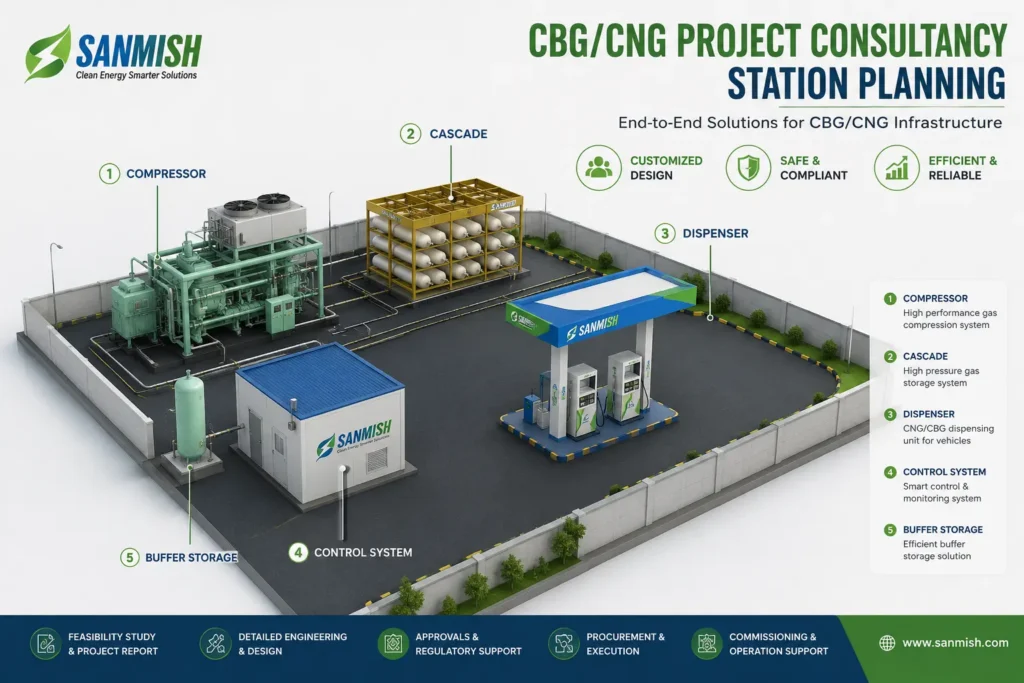
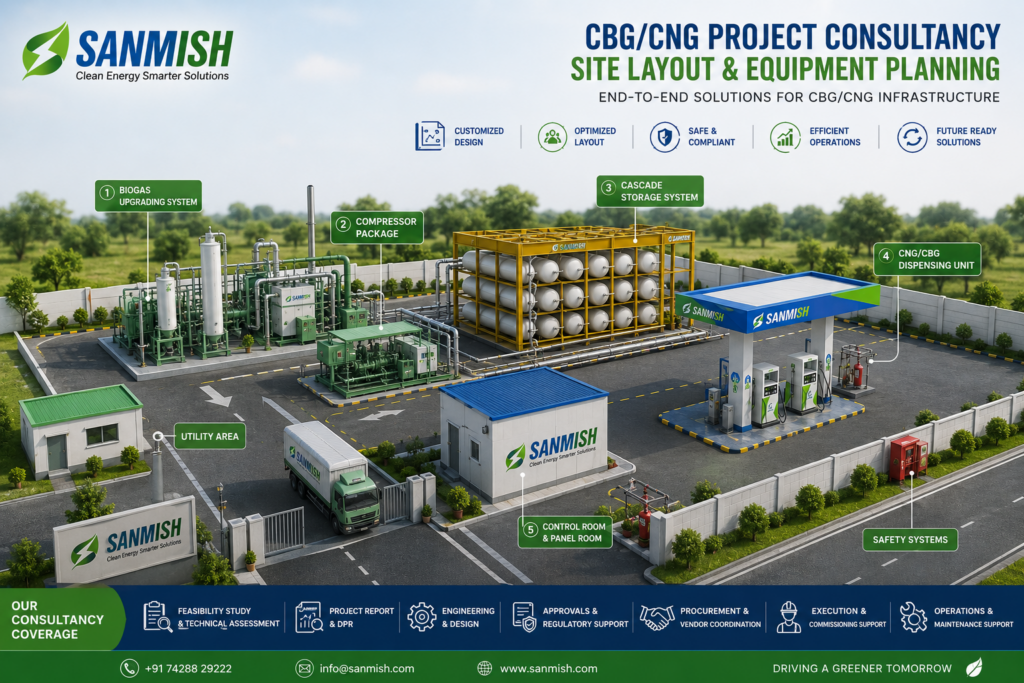
Sanmish’s portfolio includes gas compressors for CNG and CBG applications, CNG/CBG cascade systems and CNG/CBG dispensing units. Looking at these components together makes it easier to discuss how gas moves from compression to storage and finally to the vehicle or end user.
3. Approvals Need to Be Planned Early
Approvals are not an item to leave until construction is nearly complete.
The design, layout, equipment and documentation can all be affected by statutory requirements. If approval-related requirements are identified late, the project may need avoidable revisions.
Sanmish lists statutory approvals, including civic approvals, PESO-related requirements and NOCs, within its broader consultancy and project-support offering. Its dedicated PESO consultancy service also covers guidance for CNG, CBG, compressed gases and related infrastructure.
For project developers, the practical takeaway is simple: regulatory planning should run alongside engineering planning, not after it.
Project-specific requirements can vary, so the approval path should always be checked for the exact site, equipment and operating model involved.
4. Procurement Should Follow Engineering Decisions
Buying the lowest-priced component first can create a more expensive problem later.
Procurement works better when technical requirements are frozen before vendors are compared. A consultant can help define the required capacity, pressure range, configuration, controls, interfaces and site conditions so competing quotations are evaluated on the same basis.
Strong consultancy creates one technical basis for procurement so the project team and vendors are working toward the same result.
5. Station Layout Affects Day-to-Day Operations
A station can be technically functional and still be inconvenient to operate.
Vehicle movement, cascade positioning, equipment access, maintenance space, piping routes and safety clearances all influence how the site behaves after commissioning.
That is why layout planning should consider operations from day one.
A useful consultancy discussion should therefore cover more than equipment capacity. It should ask how operators will access the equipment, how vehicles will enter and leave, how maintenance will be carried out and where future expansion may take place.
6. Commercial Planning and Engineering Need to Speak to Each Other
Engineering decisions have commercial consequences.
A higher-capacity system may offer room for growth, but it can also increase initial investment. A smaller system may reduce upfront cost but struggle if demand rises faster than expected. Extra storage can improve operating flexibility, but only when it serves a real demand pattern.
This is another reason consulting should begin early. When engineering and commercial teams work from the same assumptions, it becomes easier to decide what is essential now, what can be modular and what can be added later.
7. Plan for Operations Before Commissioning
The strongest project plans treat commissioning as the start of operations, not the finish line.
Sanmish’s clean-energy offerings include gas-distribution planning, CBG design and engineering, station execution, equipment supply and operations-related support. For developers, this end-to-end view can make the transition from construction to everyday operation much smoother.
What Sanmish CBG CNG Project Consultancy Covers
Sanmish positions its CBG CNG project consultancy around customized solutions rather than a one-size-fits-all package.
Depending on the project, the discussion can cover:
- Project requirement assessment
- CBG/CNG station concept planning
- Design and engineering
- Equipment selection and sizing
- Procurement coordination
- CNG/CBG station development
- Statutory approval planning
- Civil, mechanical and electrical coordination
- Construction and execution support
- Commissioning preparation
- Operations planning
- Future expansion requirements
Sanmish’s wider offering also lists gas distribution planning, procurement and execution; CBG designing, engineering, execution and operations; and comprehensive CNG/CBG station support covering design, approvals, construction, procurement, execution and operations.
How Equipment Planning Fits Into CBG CNG Project Consultancy
Equipment selection is still a major part of a project—it simply comes after the requirement is understood.
Compressor
The compressor has to match source conditions and the gas demand expected from the station or downstream application. Capacity, suction pressure, discharge pressure, operating hours and redundancy philosophy all matter.
Cascade
A cascade provides high-pressure gas storage and can also be part of the distribution model. Required water capacity and configuration should be linked to the demand pattern, compressor recovery and transportation model.
Dispenser
For vehicle-filling stations, the dispenser has to match the intended vehicle category and required filling performance. Data integration, transaction handling and station-control requirements may also need to be considered.
Measurement and Control
Flow measurement and monitoring help operators understand what is happening inside the station. These systems should be selected around the process rather than added as an afterthought.
When these decisions sit inside one coordinated project framework, the team can evaluate the full gas path instead of optimizing one machine at the expense of another.
Why IBET Expo 2026 Is Relevant for Project Developers
IBET Expo 2026 focuses on the theme “Advancing Bioenergy Solutions for a Low Carbon World” and covers CBG alongside ethanol, biodiesel, waste-to-energy, bio-mobility, biomass, biomaterials and sustainable aviation fuel.
The official IBET Expo 2026 website provides the event programme and industry focus areas.
India’s CBG ecosystem also sits within broader initiatives such as SATAT, which was launched to develop an ecosystem for producing compressed biogas from waste and biomass and using it alongside natural gas. Project teams that want policy background can review the IndianOil SATAT overview.
For Sanmish-specific event information, the IBET Expo 2026 Greater Noida guide confirms Hall A, Stall A-40.
Questions to Resolve Before Starting a CBG/CNG Project
A first consultancy meeting becomes much more productive when the developer arrives with basic information.
Try to answer these questions before the discussion:
- What type of project are you planning—CBG production, CNG/CBG station, daughter station or industrial gas application?
- What is the expected daily gas volume?
- What gas pressure is available at the source?
- Who is the end user—retail vehicles, fleet customers, industrial buyers or another market?
- What is the expected peak demand?
- Is gas supplied by pipeline, mobile cascade or directly from production?
- What land and access conditions are available?
- Which approvals and NOCs may apply?
- What equipment has already been shortlisted, if any?
- What is the target commissioning timeline?
- Is future expansion likely?
- Who will operate and maintain the facility after commissioning?
A consultant does not need every answer on day one, but these questions quickly reveal where more study is required.
Who Should Consider CBG CNG Project Consultancy?
CBG CNG project consultancy can be useful for businesses at different stages of development, including:
- CBG plant developers
- Bio-CNG entrepreneurs
- CNG station owners
- City gas distribution partners
- Fleet operators planning captive filling infrastructure
- EPC contractors
- Industrial gas users
- Investors evaluating CBG opportunities
- Businesses expanding existing gas infrastructure
- Companies planning compressor, cascade or dispenser upgrades
It is particularly useful when a business is entering the sector for the first time or when several technical packages need to be integrated under one project.
IBET Expo 2026 Details
| Event Detail | Information |
| Event | 3rd India Bio Energy & Tech Expo 2026 |
| Dates | 11–13 August 2026 |
| Venue | India Expo Centre & Mart |
| Location | Greater Noida, Uttar Pradesh |
| Sanmish | Hall A, Stall A-40 |
| Main Relevance | CBG, bioenergy technology and clean-energy infrastructure |
If you are attending IBET with a live project, take more than a business card. Carry a one-page note with your project capacity, site location, gas source, end-use requirement and current stage of development. It will make your discussion far more useful.
Frequently Asked Questions
What is CBG CNG project consultancy?
CBG CNG project consultancy is professional support for planning and developing compressed biogas or compressed natural gas infrastructure. It can include requirement assessment, design, engineering, equipment planning, approvals, procurement, execution and operations support.
When should a developer hire a CBG CNG consultant?
The best time is usually before major equipment is purchased. Early consultancy gives the team a chance to establish the technical basis, approval path and station configuration before large capital commitments are made.
Can consultancy include equipment selection?
Yes. Equipment planning can include compressors, cascades, dispensers, measurement systems and related high-pressure gas infrastructure, depending on the project scope.
Does Sanmish provide CBG CNG consultancy?
Yes. Sanmish states that it provides customized CBG and CNG solutions covering design, engineering and execution, with broader offerings that include station planning, procurement, approvals and operations-related support.
Does CBG CNG project consultancy include PESO support?
Approval requirements depend on the project, but Sanmish separately provides PESO consultancy and lists statutory approvals and NOCs within its wider project-support offering.
Where can I meet Sanmish at IBET Expo 2026?
Sanmish is participating at Hall A, Stall A-40 at the India Expo Centre & Mart, Greater Noida, during 11–13 August 2026.
Final Takeaway
The biggest lesson from IBET Expo 2026 for project developers is that successful gas infrastructure starts with the right questions, not the first equipment quotation.
CBG CNG project consultancy helps connect feasibility, engineering, approvals, procurement, construction and operations before those decisions become expensive to change.
If you are planning a new CBG/CNG project or upgrading existing infrastructure, bring your project details to Sanmish Energies, Hall A, Stall A-40. A focused technical discussion around your actual capacity, site and operating model can help turn a broad idea into a clearer project plan.