
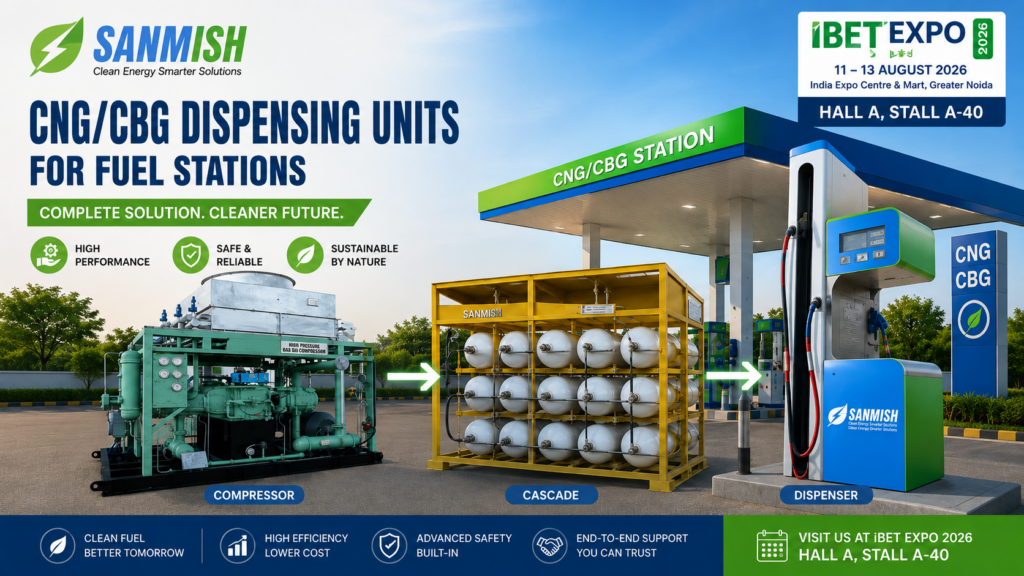
CNG/CBG dispensing units are one of the most practical pieces of equipment to evaluate when planning or upgrading a CNG, CBG or Bio-CNG fuel station. At IBET Expo 2026 in Greater Noida, buyers can move beyond brochures and discuss real station requirements—vehicle type, filling speed, payment workflow, data integration and the equipment that sits behind the dispenser.
Sanmish Energies is showcasing its clean-energy solutions at Hall A, Stall A-40 during the 3rd India Bio Energy & Tech Expo, being held from 11 to 13 August 2026 at the India Expo Centre & Mart, Greater Noida.
For station owners, project developers, EPC companies and fleet operators, the conversation around a dispenser is simple: it must fill vehicles accurately, fit the station’s operating model and work smoothly with the rest of the gas infrastructure.
Quick answer: Sanmish offers car, combo and bus CNG/CBG/LPG dispensers in single- and dual-arm configurations. Its product page lists minimum delivery rates of 15 kg/min for car applications and 75 kg/min for bus applications, along with SCADA/MODBUS connectivity, RFID compatibility, transaction-data software, security features and an integrated thermal printer.
What Are CNG/CBG Dispensing Units?
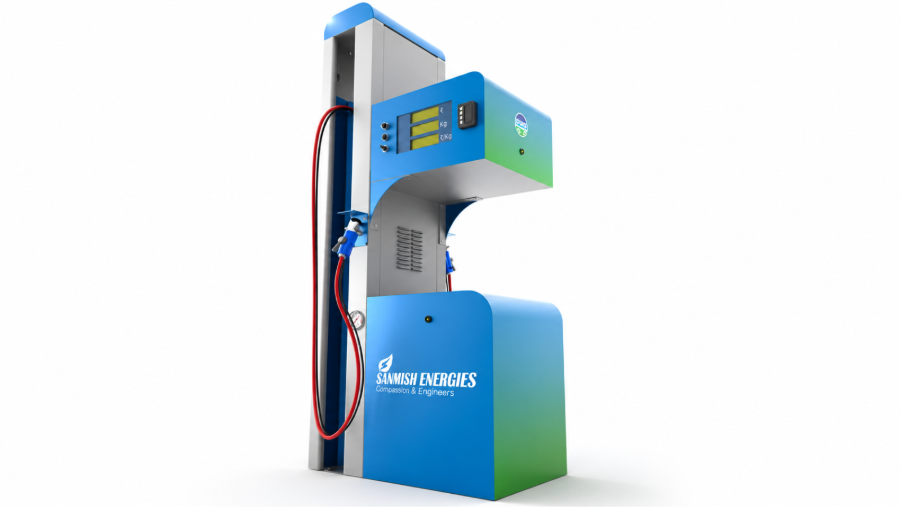
CNG/CBG dispensing units are the customer-facing part of a compressed-gas filling station. They control the delivery of compressed natural gas or compressed biogas from the station system into a vehicle’s onboard cylinder.
From the driver’s point of view, the dispenser is where the transaction happens. For the station operator, however, it is also a measurement, control and data point within a much larger system.
A typical CNG or CBG station may include a gas source, compression equipment, high-pressure storage, priority control, piping, safety components and dispensing equipment. Each part has to match the station’s capacity and operating pattern.
That is why choosing a CNG fuel station dispenser only by cabinet size or appearance is rarely enough. The right question is whether the unit suits the type and number of vehicles the station expects to serve.
For detailed product information, see the Sanmish CNG/CBG/LPG Dispenser page.
Why Fuel Stations Need the Right Dispenser
A busy retail station and a fleet-oriented filling point do not work in the same way.
A car-focused outlet may deal with many short transactions throughout the day. A bus depot may need fewer transactions but a much higher gas flow per vehicle. A mixed station may need to handle both without creating unnecessary queues.
This makes CNG/CBG dispensing units an operational decision, not merely a purchasing decision.
Station owners should think about:
- Vehicle mix: cars, commercial vehicles, buses or a combination
- Expected peak-hour traffic
- Required filling rate
- Single-arm versus dual-arm configuration
- Transaction recording
- Payment and fleet identification
- SCADA or station-control integration
- Printer and customer-receipt requirements
- Security and operator access
- Maintenance access and service support
A dispenser that fits the station’s real traffic pattern can help the site run more smoothly, especially during peak filling hours.
Sanmish CNG/CBG Dispensing Units at IBET Expo 2026
Visitors looking for CNG/CBG dispensing units can meet the Sanmish team at Hall A, Stall A-40.
According to Sanmish’s current dispenser product page, the company offers car, combo and bus dispensers with single- or dual-arm configurations.
The listed minimum dispensing rates are:
| Application | Listed Minimum Rate |
| Car | 15 kg/min |
| Bus | 75 kg/min |
Those figures are useful starting points, but buyers should discuss their actual duty cycle, upstream pressure, vehicle mix and station design before selecting equipment.
Sanmish also states that PESO and Weights & Measures approvals are under process for these dispensers. Approval status can change, so project buyers should confirm the latest position directly with Sanmish before procurement or commissioning.
Key Features to Discuss at the Sanmish Stall
1. Car, Combo and Bus Filling Options
Not every station serves the same vehicle profile. Sanmish lists dispenser configurations for cars, combo applications and buses.
This matters because a dispenser intended for a city car outlet may have different operational priorities from equipment installed at a bus fleet or transport hub.
When you visit IBET, tell the team what vehicles you expect to serve and how many vehicles typically arrive during your busiest hour.
2. Single- and Dual-Arm Configurations
The choice between single- and dual-arm CNG/CBG dispensing units depends on the station layout and operating plan.
A dual-arm configuration can make sense where the site is designed to manage more than one filling position or where operational flexibility is important. The best configuration still depends on the complete station design rather than the dispenser alone.
3. SCADA Connectivity Through MODBUS
Modern fuel stations increasingly need equipment to communicate with a central control or monitoring system.
Sanmish states that its dispenser is compatible with SCADA systems through the MODBUS protocol. For operators already using station automation, this is worth discussing in detail at the expo.
Ask which parameters can be monitored, how data is transferred and what integration work is required with your existing SCADA environment.
4. Sales Data Without SCADA
Not every filling location has a full SCADA setup.
Sanmish also lists OEM software that can download CNG sales data to a personal computer where SCADA is not available. This may be useful for smaller stations oroperators that need transaction records without implementing a larger automation platform from day one.
5. RFID for Payment and Queue Management
Fleet stations often need to identify vehicles quickly.
The Sanmish dispenser page lists an RFID-compatible system designed to support payment and queue-management workflows. For fleet owners, this can be relevant when vehicles return to the same station frequently and manual identification adds unnecessary steps.
6. Operator and Transaction Security
Fuel dispensing involves both product control and money.
Sanmish lists a fingerprint reader for added security, along with an audio “CHECK ZERO” and “AMOUNT PAYABLE” function. An integrated thermal printer is also included in the listed feature set.
These may sound like small details, but at a busy retail outlet they directly affect how operators and customers interact with the unit.
7. Dual Pricing Capability
Sanmish also lists a dual-pricing feature that can be controlled through both an integrated keypad and SCADA.
If a station serves different customer categories, fleets or pricing arrangements, this is a feature worth discussing with the technical team before deciding how it would be configured in practice.
How a Dispenser Fits Into a Complete CNG/CBG Station
A dispenser cannot perform well if the upstream station is poorly matched.
The gas has to reach the dispenser at the required conditions, which means compression, storage and control equipment need to be considered together.
For a typical project, that conversation may include:
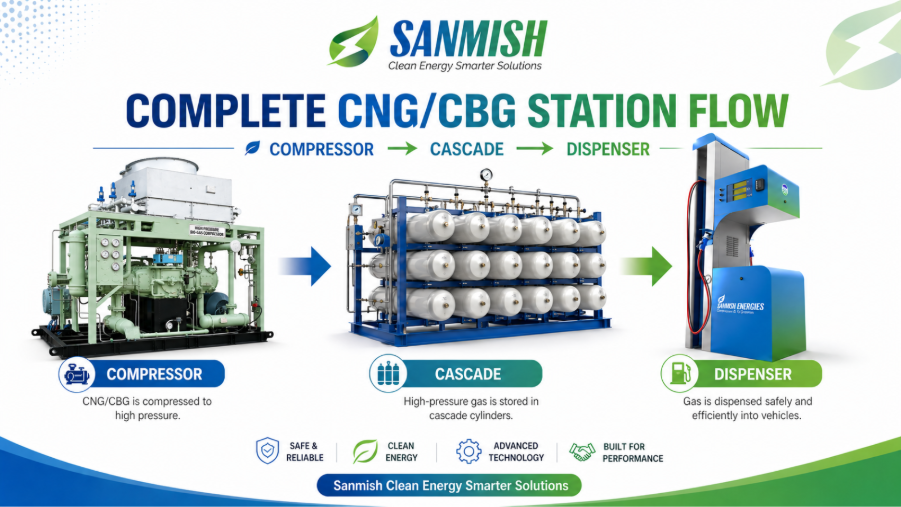
Compression: The Sanmish gas compressor range is intended for CNG, CBG and hydrogen applications. Compressor sizing depends on station demand, source pressure and the expected filling profile.
High-pressure storage: CNG/CBG/Hydrogen cascades provide high-pressure gas storage and can form an important part of a station or transport-based supply system.
Dispensing: The CNG/CBG dispensing units are where compressed gas is delivered to the vehicle and the filling transaction is completed.
Project planning: Businesses that need help connecting these pieces can review Sanmish’s CBG/CNG consultancy services, which cover customized design, engineering and execution support.
Thinking about these components as one system helps prevent a common project problem: buying individually suitable equipment that does not work optimally when combined.
What Buyers Should Check Before Selecting a Dispenser
An expo is most useful when you arrive with project information in hand.
Before discussing CNG/CBG dispensing units, write down a few basics about your planned station:
- What gas will the station dispense—CNG, CBG/Bio-CNG, or both?
- Is the site a retail outlet, fleet station, daughter station or another configuration?
- What types of vehicles will use it?
- How many vehicles do you expect during peak periods?
- What filling rate do you need?
- What is the available inlet pressure at the dispenser?
- Will you require single- or dual-arm dispensing?
- Do you already use SCADA?
- Do you need RFID-based fleet identification?
- What transaction reports and printer functions are required?
- What statutory approvals are applicable to the project?
- Who will provide installation, commissioning and after-sales support?
This information turns a general product discussion into a useful engineering conversation.
India’s retail CNG infrastructure is subject to technical and safety requirements. Project developers can review the current PNGRB Technical Standards and Safety Standards for Retail Outlets and should confirm the regulations and approvals applicable to their specific project.
Why See CNG/CBG Dispensing Units at IBET Expo 2026?
Online specifications are useful, but they do not always answer practical questions.
At a trade exhibition, you can explain your station layout, vehicle mix and operating conditions directly to the supplier. You can also discuss the equipment that needs to work around the dispenser.
The 3rd India Bio Energy & Tech Expo covers compressed biogas alongside ethanol, biodiesel, waste-to-energy, bio-mobility, biomass, biomaterials and sustainable aviation fuel. The official IBET Expo 2026 website lists the event for 11–13 August 2026 at India Expo Centre & Mart, Greater Noida.
Sanmish’s own IBET Expo 2026 exhibitor guide places the company at Hall A, Stall A-40.
For a buyer already working on a filling-station project, that makes the expo a useful place to compare the dispenser with the compressor, cascade and broader station architecture in one conversation.
IBET Expo 2026 Details
| Event Detail | Information |
| Event | 3rd India Bio Energy & Tech Expo 2026 |
| Dates | 11–13 August 2026 |
| Venue | India Expo Centre & Mart |
| City | Greater Noida, Uttar Pradesh |
| Sanmish Location | Hall A, Stall A-40 |
| Relevant Focus | CBG, Bio-CNG and clean-energy infrastructure |
If CNG/CBG dispensing units are on your procurement list, take your basic project data with you. Even a short note containing flow requirements, vehicle type and station configuration can make the discussion much more specific.
Questions to Ask Sanmish at Hall A, Stall A-40
When you meet the team, avoid starting with only, “What is the dispenser price?”
A better first discussion covers the operating requirement.
Ask:
- Which dispenser configuration fits my vehicle mix?
- What filling rate should I plan for?
- How does the unit connect with my compressor and cascade?
- What SCADA integration is available?
- How is sales data stored when SCADA is not installed?
- How does RFID work for fleet vehicles?
- What approval status applies to the exact model being quoted?
- What site conditions are needed before installation?
- What commissioning and service support is available?
The answers will give you a better basis for comparing CNG/CBG dispensing units than price alone.
Frequently Asked Questions
What are CNG/CBG dispensing units?
CNG/CBG dispensing units are fuel-station systems used to deliver compressed natural gas or compressed biogas into vehicle cylinders while supporting measurement, control and transaction functions.
What types of dispensers does Sanmish offer?
Sanmish currently lists car, combo and bus CNG/CBG/LPG dispensers in single- and dual-arm configurations.
What filling rates are listed for Sanmish dispensers?
The Sanmish product page lists a minimum of 15 kg/min for car applications and 75 kg/min for bus applications.
Can the dispenser connect to SCADA?
Sanmish states that its dispenser supports SCADA connectivity through the MODBUS protocol. Buyers should discuss their existing control system and integration requirements before ordering.
Does Sanmish support RFID?
Yes. RFID compatibility is listed as a feature for payment and queue-management applications.
Where can I see Sanmish at IBET Expo 2026?
Sanmish is exhibiting at Hall A, Stall A-40 at India Expo Centre & Mart, Greater Noida, during 11–13 August 2026.
Are Sanmish CNG/CBG dispensers PESO approved?
Sanmish’s current product page states that PESO and Weights & Measures approval is under process. Buyers should confirm the latest model-specific approval status with Sanmish before procurement.
Final Takeaway
For a fuel station, the dispenser is where engineering meets the customer.
Good CNG/CBG dispensing units need to match the vehicles being served, the station’s peak demand, upstream compression and storage, control-system requirements and day-to-day transaction workflow.
IBET Expo 2026 gives project developers and station operators a chance to discuss those details directly. If you are planning a CNG, CBG or Bio-CNG filling facility, visit Sanmish Energies at Hall A, Stall A-40 and take your project requirements with you.
A focused ten-minute technical discussion can be far more useful than comparing specification sheets without the context of your actual station.