
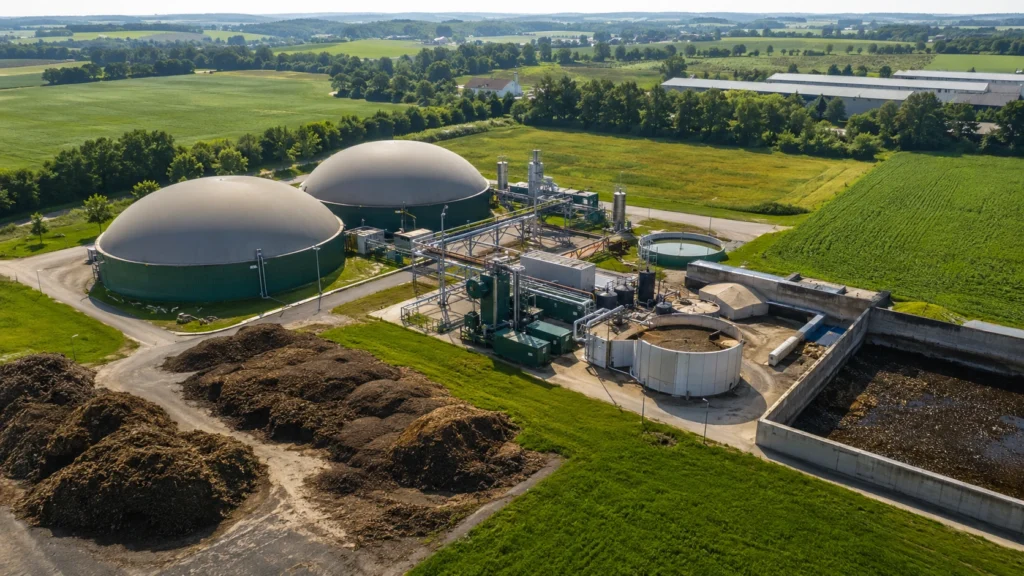
A biogas plant converts organic waste into usable clean energy through a natural biological process. Whether it is farm waste, food scraps, animal manure, or sewage sludge, a biogas plant can turn that waste into fuel for cooking, electricity generation, and even vehicle fuel.
India alone generates over 600 million tonnes of organic waste each year. Most of it ends up in landfills, releasing harmful greenhouse gases. A biogas plant changes that equation completely. It captures those gases, uses them productively, and leaves behind a nutrient-rich residue that works beautifully as organic fertilizer.
If you are curious about setting up a biogas plant, understanding how one works, or just exploring renewable energy options, you are in the right place. This guide walks you through everything, from the basics of anaerobic digestion to costs, types, government subsidies, and common mistakes to avoid.
What Is a Biogas Plant?
A biogas plant is a facility where organic matter is broken down by bacteria in the absence of oxygen. This process is called anaerobic digestion. The breakdown produces a mixture of gases, mainly methane (50-70%) and carbon dioxide (30-40%), with small traces of hydrogen sulfide and water vapor.
That gas mixture is what we call biogas. It burns cleanly and can be used directly for cooking, heating, or generating electricity. After the organic material has been fully digested, what remains is called digestate, a wet, nutrient-dense slurry that makes excellent bio-fertilizer.
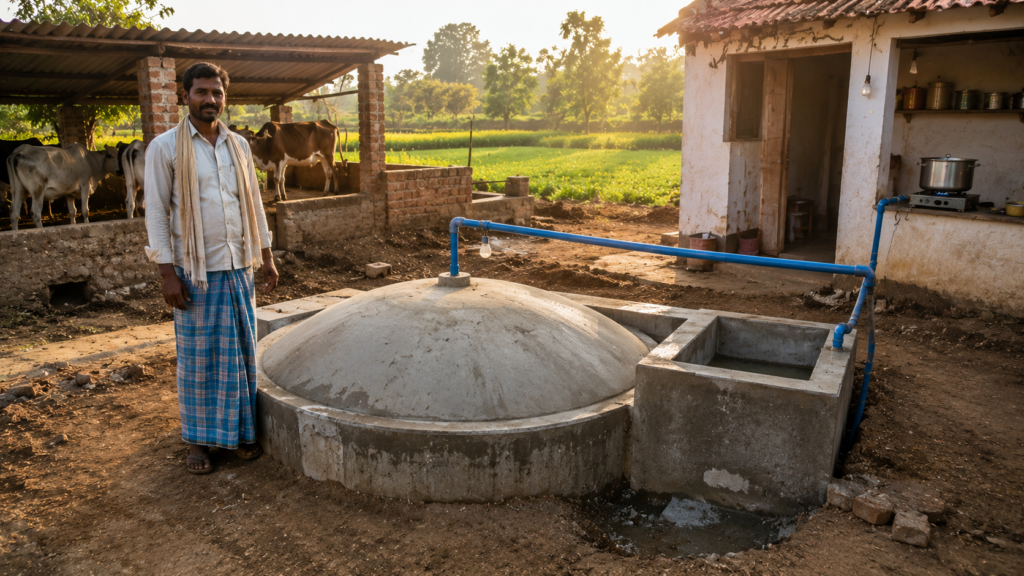
The concept is not new. China and India have been using small biogas digesters for decades. What has changed is the scale and sophistication. Today, biogas plants range from small household units producing enough gas to cook three meals a day, all the way to massive industrial plants that feed electricity into the national grid.
How Does a Biogas Plant Work?
The working of a biogas plant follows a four-stage biological process. Understanding each stage helps you manage the plant better and troubleshoot problems early.
Stage 1: Hydrolysis
Complex organic compounds like carbohydrates, fats, and proteins are broken down into simpler molecules. Bacteria produce enzymes that dissolve these large molecules into sugars, fatty acids, and amino acids. This stage is the slowest part of the process.
Stage 2: Acidogenesis
The simpler molecules from hydrolysis are further broken down by acidogenic bacteria. This produces volatile fatty acids, ammonia, carbon dioxide, and hydrogen. The environment becomes acidic during this phase.
Stage 3: Acetogenesis
Acetogenic bacteria convert the volatile fatty acids into acetic acid, hydrogen, and carbon dioxide. These are the direct precursors of methane.
Stage 4: Methanogenesis
This is the final and most important stage. Methanogenic archaea convert acetic acid and hydrogen into methane and carbon dioxide. The result is the biogas that collects in the dome or storage system above the digester.
The entire cycle from feeding raw material to gas production typically takes 20 to 40 days depending on temperature, feedstock type, and digester design.
Types of Biogas Plants
Not every biogas plant looks or works the same. The right type depends on the scale, feedstock, and intended use. Here are the main categories:
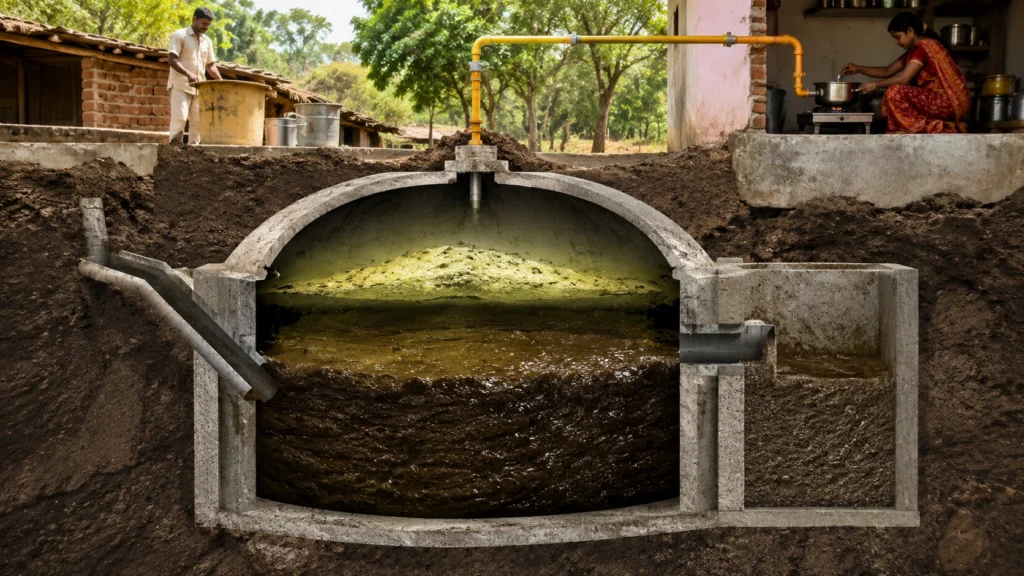
Fixed-Dome Biogas Plant
- Built underground with a fixed, non-moving dome
- The gas collects at the top of the dome and pushes the slurry down into a displacement chamber
- Low maintenance and long lifespan (20+ years)
- Best suited for household and small community use
- Common in rural India and China
Floating-Drum Biogas Plant
- Has a steel or fiberglass drum that floats on the slurry and rises as gas accumulates
- Provides constant gas pressure, which is convenient for cooking
- More expensive than fixed-dome models due to the metal drum
- Drum can rust over time, requiring replacement every 5-10 years
Plug Flow Digester
- Horizontal digester where material flows in from one end and exits from the other
- Suitable for high-solid feedstocks like cattle manure and crop residues
- Simple to operate but requires large land area
Continuous Stirred Tank Reactor (CSTR)
- Industrial-scale digester with mechanical mixing
- Handles a wide variety of feedstocks including food waste and sewage sludge
- Higher capital cost but maximum biogas output per unit volume
- Used in large municipal and commercial plants
Tubular Digester
- A long polyethylene tube acts as the digester
- Very low cost and easy to install
- Common in Latin America and Southeast Asia
- Shorter lifespan than fixed structures
Biogas Plant vs Other Renewable Energy Sources
| Feature | Biogas Plant | Solar PV System | Wind Turbine |
|---|---|---|---|
| Feedstock | Organic waste | Sunlight | Wind |
| 24/7 Availability | Yes | No (night/cloudy) | No (calm days) |
| Waste Management | Yes, reduces waste | No | No |
| Byproduct | Bio-fertilizer | None | None |
| Land Requirement | Moderate | Moderate-High | High |
| Setup Cost (India) | Rs. 15,000-50 lakhs+ | Rs. 40,000-5 lakhs+ | Rs. 5 lakhs+ |
| Maintenance | Medium | Low | Medium-High |
| Carbon Offset | High (methane capture) | Moderate | Moderate |
| Best Suited For | Farms, industries, cities | Homes, rooftops | Open areas |
Key Components of a Biogas Plant
A well-designed biogas plant has several interconnected components. Each part plays a specific role:
Inlet Chamber
This is where raw organic material, mixed with water, enters the digester. The mixture (called slurry) is usually prepared at a 1:1 ratio of waste to water. The inlet must be designed to prevent air from entering, since anaerobic digestion requires an oxygen-free environment.
Digester Tank
The main chamber where anaerobic digestion happens. It is fully sealed, often built underground, and can be cylindrical or rectangular. The size of the digester determines how much biogas the plant can produce. For a family of 5-6 members, a 2-cubic-meter digester is usually sufficient.
Gas Storage Dome or Bag
The biogas that rises from the digester is stored in a dome (in fixed-dome models) or a flexible gas bag. From here, it travels through pipelines to the point of use. Industrial plants use separate gas holders with pressure control systems.
If you are looking for professional-grade biogas measurement and control systems, biogas analyzers and monitoring equipment ensure accurate gas quality readings before the gas enters the utilization system.
Outlet Chamber
Spent slurry exits through the outlet and collects in an overflow tank or drainage channel. This digestate is nutrient-rich and can be applied directly to fields as bio-fertilizer.
Gas Purification System (for CBG Plants)
Large plants that want to upgrade biogas to Compressed Bio-Gas (CBG) quality need purification units to remove CO2, H2S, and moisture. The output is biomethane with 90%+ methane content. For distribution, CBG dispensers and filling infrastructure are critical components. Learn how CNG/CBG dispensers and filling systems work in commercial biogas operations.
Benefits of a Biogas Plant
Installing a biogas plant delivers a wide range of benefits that go well beyond just fuel production. Here is why more farmers, municipalities, and industries are making the shift:
Environmental Benefits
- Reduces greenhouse gas emissions: Methane from decomposing organic waste is 25 times more potent than CO2. Capturing it in a biogas plant prevents it from entering the atmosphere.
- Replaces fossil fuels: Every cubic meter of biogas produced replaces roughly 0.46 kg of LPG, reducing dependence on imported fossil fuels.
- Improves soil health: Digestate returned to fields increases soil organic matter and reduces the need for chemical fertilizers.
- Reduces water pollution: Proper digestion of animal waste reduces nitrate and pathogen contamination of groundwater.
Economic Benefits
- Saves money on fuel: A household biogas plant can completely eliminate LPG costs, saving Rs. 800-1,200 per month in fuel expenses.
- Earns carbon credits: Registered biogas plants can earn verified carbon credits, creating an additional revenue stream.
- Reduces fertilizer costs: Bio-slurry replaces synthetic fertilizers, potentially saving Rs. 5,000-15,000 per acre annually.
- Job creation: Large biogas plants create local employment in plant operation, feedstock collection, and maintenance.
Social Benefits
- Improves indoor air quality: Replacing firewood with biogas eliminates smoke in kitchens, reducing respiratory illness.
- Empowers women: Women in rural households spend fewer hours collecting firewood and have cleaner cooking conditions.
- Waste management solution: Converts animal and food waste into value, reducing open burning and dumping.
Challenges of Setting Up a Biogas Plant
No technology is without its hurdles. Being aware of these challenges helps you plan better:
- High upfront cost: A commercial biogas plant requires significant capital investment. Small household plants are more accessible but still require Rs. 15,000-30,000 in India.
- Feedstock consistency: The plant needs a steady supply of organic material. Seasonal variations in feedstock availability can affect gas production.
- Technical knowledge gap: Proper operation requires understanding of pH levels, temperature management, and carbon-to-nitrogen ratios.
- Digestate management: While digestate is valuable, handling and distributing large quantities requires proper infrastructure.
- H2S corrosion: Hydrogen sulfide in biogas is corrosive and can damage pipes and engines. Gas purification or desulfurization units are essential for equipment protection.
- Cold weather impact: Anaerobic bacteria slow down in cold temperatures. Plants in hilly or cold regions need insulation or heating systems.
- Land requirements: Even a medium-sized biogas plant needs dedicated land that many urban users may not have.
Step-by-Step Guide to Setting Up a Biogas Plant
Whether you are setting up a small household unit or a medium-scale farm plant, the process follows a similar sequence.
Step 1: Assess Your Feedstock
Calculate how much organic waste you generate daily. As a thumb rule, 25-30 kg of cattle dung produces approximately 1 cubic meter of biogas per day. Food waste produces slightly more gas per kilogram due to higher carbohydrate content. Document your waste type, volume, and consistency.
Step 2: Choose the Right Plant Size
Match your digester size to your daily waste input and energy need. A 1 cubic meter plant produces roughly 1,500-2,000 kcal of energy per day, enough for 2-3 hours of cooking. Size up if you plan to generate electricity or produce CBG for commercial use.
Step 3: Select the Digester Type
Based on your location, budget, and feedstock, choose between fixed-dome, floating-drum, CSTR, or plug-flow digesters. For rural households, fixed-dome is the most practical. For industrial applications, CSTR with mixing systems delivers the highest efficiency.
Step 4: Choose the Installation Site
Pick a location that:
- Receives sunlight for passive heating
- Is close to your waste source (reduces transportation)
- Has drainage provision for digestate
- Is accessible for maintenance
- Is at least 15 meters from drinking water sources
Step 5: Get Necessary Approvals
In India, biogas plants above a certain size may require clearance from the local municipal body, State Pollution Control Board, and potentially PESO (for gas infrastructure). Working with an experienced CBG/CNG consultancy can simplify this process significantly. CBG and CNG consultancy services help navigate regulatory requirements for larger biogas projects.
Step 6: Construct or Install the Plant
For small plants, certified masons trained in biogas construction can build a fixed-dome digester in 7-10 days. For larger systems, turnkey project companies handle civil, mechanical, and electrical construction end to end. Professional civil, mechanical, and electrical construction services for biogas and gas infrastructure can significantly reduce setup time and compliance risk.
Step 7: Commission and Start Feeding
Start with a seed inoculum, which is a small amount of active digestate from an existing plant or well-decomposed animal manure. Feed the plant daily with fresh slurry at the correct water ratio. Gas production usually begins within 15-30 days.
Step 8: Monitor and Maintain
Check pH levels monthly (ideal range: 6.5-7.5), inspect for gas leaks weekly, clear inlet blockages regularly, and drain digestate as needed. For industrial plants, install gas flow meters and analyzers to track production efficiency continuously.
Biogas Plant Cost in India
Cost varies significantly based on scale, type, and location. Here is a practical breakdown:
| Plant Type | Capacity | Approximate Cost (INR) | Suitable For |
|---|---|---|---|
| Household Fixed-Dome | 1-4 cu.m | Rs. 15,000-50,000 | Family of 4-8 |
| Small Community Plant | 10-25 cu.m | Rs. 1.5 – 5 Lakhs | 10-30 households |
| Farm-Scale Plant | 25-100 cu.m | Rs. 5 – 25 Lakhs | Dairy farms, piggeries |
| Commercial CBG Plant | 500-2000 cu.m/day | Rs. 2 – 10 Crores | Industrial scale |
| Municipal Biogas Plant | 5,000+ cu.m/day | Rs. 20+ Crores | City-level waste management |
Costs include civil construction, pipelines, gas purification (where applicable), and initial commissioning. Subsidies from MNRE can offset 25-75% of the base cost for eligible applicants.
Government Subsidies and Policies
India has some of the most progressive biogas support policies in the world. Here is what you need to know:
GOBAR-DHAN Scheme
Launched in 2018 and significantly expanded since, the Galvanizing Organic Bio-Agro Resources Dhan (GOBAR-DHAN) scheme supports construction of biogas plants in rural areas. It provides financial assistance, technical support, and links biogas plants to CBG production targets.
National Biogas and Manure Management Programme (NBMMP)
Run by the Ministry of New and Renewable Energy (MNRE){target=”_blank”}, this programme offers subsidies ranging from Rs. 7,000 to Rs. 20,000 per household biogas plant depending on the state and beneficiary category. SC/ST and BPL households receive higher support.
Sustainable Alternative Towards Affordable Transportation (SATAT) Initiative
The SATAT initiative, launched by the Ministry of Petroleum and Natural Gas, targets the production of Compressed Bio-Gas (CBG) from organic waste. Under this scheme, entrepreneurs can set up CBG plants and sell the gas to oil marketing companies at a government-notified price. This creates a clear commercial pathway for larger biogas investments.
Carbon Credit Mechanism
Registered biogas plants in India can earn Verified Carbon Units (VCUs) under international carbon markets. This creates an additional annual income of Rs. 1.5-4.5 lakhs per year for a medium-sized plant. The EPA’s guidelines on greenhouse gas emission reduction{target=”_blank”} provide internationally recognized frameworks that Indian plants often align with for carbon credit certification.
Common Mistakes When Setting Up a Biogas Plant
These are mistakes that trip up first-time biogas plant owners. Learn from them before you start:
- Skipping the inoculum: Starting with fresh waste only, without a seed culture of active bacteria, delays gas production by weeks. Always add digestate from a working plant or old dung slurry to jumpstart the process.
- Wrong water ratio: Adding too little or too much water disrupts the slurry consistency. A 1:1 ratio of dung to water is the standard starting point.
- Ignoring pH: If the digester becomes too acidic (pH below 6), methanogens die off. This is usually caused by overfeeding or adding too much food waste. Test pH monthly.
- Mixing incompatible feedstocks: Not all organic matter digests well together. High-fat materials like grease can coat bacteria and kill them. Feedstock testing before full-scale loading saves a lot of trouble.
- No desulfurization: Hydrogen sulfide in raw biogas corrodes metal pipes, pressure gauges, and engines. A simple iron oxide scrubber or biological desulfurization unit is non-negotiable for any plant feeding a generator or compressor.
- Underestimating civil work: Poor construction leads to gas leaks, structural cracks, and contamination. Use trained masons and good quality materials, even for a small household plant.
- Neglecting maintenance: Many biogas plants fall idle within 2-3 years simply because of neglected maintenance. Set a monthly inspection schedule and stick to it.
Best Practices for Running a Biogas Plant Efficiently
These practices will help you maximize output and extend the lifespan of your plant:
- Feed consistently: Daily feeding at the same time keeps bacterial activity stable. Irregular feeding creates boom-and-bust cycles that reduce efficiency.
- Maintain temperature: The ideal temperature for mesophilic bacteria (most common type) is 30-40°C. In winter, insulate the digester or use solar thermal covers.
- Monitor gas quality: Install a basic biogas analyzer to track methane percentage and detect H2S spikes early.
- Use pre-treatment for tough feedstocks: Shredding food waste or crop residues before feeding significantly speeds up hydrolysis and increases gas yield.
- Keep the inlet and outlet clear: Fibrous materials like hay and corn stalks can clog the inlet pipe. Screen or chop them before adding.
- Use the digestate properly: Apply bio-slurry to crops in the early morning or evening to prevent nutrient loss from evaporation. Compost dried digestate for better handling.
- Document production: Keep a simple logbook of daily feed volume, gas production, and observations. This data helps identify performance trends and troubleshoot problems faster.
- Partner with equipment suppliers who understand gas systems: For plants that involve compression, dispensing, or CBG production, working with specialists in CNG/CBG cascade systems and compression equipment ensures your gas handling infrastructure meets safety and performance standards.
Frequently Asked Questions
1. How much biogas does 1 kg of cow dung produce?
One kilogram of fresh cow dung produces approximately 40-50 liters of biogas. The exact volume depends on the age of the dung, its water content, and the digester temperature. Fresh dung gives more gas than dried or aged dung.
2. Can a biogas plant work during winter?
Yes, but production slows down significantly when temperatures drop below 15°C. Anaerobic bacteria work best between 30-40°C. To maintain output in winter, insulate the digester with straw or polythene covers, build the plant in a sun-facing location, or use a small biogas-powered heater to warm the digester.
3. Is the gas from a biogas plant safe for cooking?
Biogas is very safe for cooking when properly piped and used with the right burners designed for low-pressure gas. Unlike LPG, it burns at a lower pressure, so standard LPG stoves may need minor adjustments. Always use ISI-marked fittings and keep the kitchen ventilated.
4. What materials can be used as feedstock in a biogas plant?
Good feedstocks include cattle and buffalo dung, pig manure, poultry litter, food and kitchen waste, agricultural residues, sewage sludge, and press mud from sugar mills. Materials to avoid include wood, plastic, metals, oily waste in large quantities, and materials treated with antibiotics or pesticides, as these inhibit or kill the bacteria.
5. How long does it take for a biogas plant to start producing gas?
A new biogas plant typically starts producing gas within 20-40 days of the first feeding. The exact time depends on the type of feedstock, the quality of the inoculum added, and the ambient temperature. Output increases gradually and reaches full capacity after 2-3 months of stable operation.
6. Can biogas be used to generate electricity?
Yes. Biogas can fuel a gas generator (genset) to produce electricity. Roughly 1 cubic meter of biogas produces about 1.5-2 kWh of electricity. For this purpose, the biogas should first be purified to remove H2S and moisture to protect the engine. Medium and large plants often use Combined Heat and Power (CHP) systems that generate both electricity and useful heat simultaneously, maximizing efficiency.
7. What is the difference between biogas and CBG?
Biogas is the raw gas from the digester, containing 50-70% methane along with CO2, H2S, and water vapor. Compressed Bio-Gas (CBG) is biogas that has been purified to remove CO2, H2S, and moisture, leaving behind 90%+ pure methane. It is then compressed to 200-250 bar pressure, making it equivalent to CNG and usable as vehicle fuel.
8. Do I need a license to set up a biogas plant in India?
For small household biogas plants (up to 4 cubic meters), no special license is needed. Larger plants, especially those producing CBG for commercial sale or generating electricity for grid export, require registration with PESO, environmental clearances from the State Pollution Control Board, and compliance with local municipal regulations. The exact requirements vary by state.
Conclusion
A biogas plant is one of those rare technologies that solves multiple problems at once. It handles organic waste, produces clean energy, creates bio-fertilizer, and reduces greenhouse gas emissions, all in a single system. Whether you are a farmer looking to cut LPG costs, an entrepreneur exploring the CBG opportunity, or a municipality trying to manage organic waste at scale, a biogas plant deserves serious consideration.
The technology is proven, the policies are supportive, and the economics are increasingly favorable. The key is to plan carefully, choose the right plant type for your needs, and work with experienced partners for construction, equipment, and compliance.
If you are ready to explore biogas and compressed bio-gas infrastructure for your project, reach out to specialists who understand the full value chain: from plant design and PESO approvals to gas compression and dispensing systems. Contact Sanmish to discuss your biogas or CBG project needs with experienced engineers.